SPACE FRAME

Construction
A major advantage of space frame technology is environmental due to the significant reduction in parts and material necessary to construct a structural element which leads to a much less weight of the final product. This simplifies and reduces the cost of transport and use, as well as minimizing energy and resource consumption. The use of modular space frame elements, in construction reduces assembly time and therefore labor costs. The increased strength-to-weight ratio of space frame technology yields elements that are not otherwise possible, using older structural designs, and because of the reduction in resource consumption and energy used, in fabrication and implementation of space frame in construction, it’s use is environmentally responsible.
Space frame structures economize on materials are lightweight and very strong.




The late 19th century saw increasing interest in taller buildings and aeronautics, which required greater strength to weight ratios of structures than could be achieved with the methods and materials that had been used during the preceding millennia. Iron and then steel were introduced as framing materials. Experimentation began into the geometry of stress transfers, through structures of various materials, resulting in space frame. This versatile innovation was essential to the development of airplanes and has been applied to many production engineering tasks. Space frame now provides the integrity to be used in structures from skyscrapers to planetary rovers.
Design
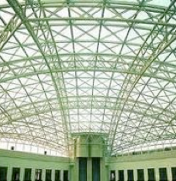
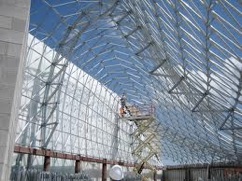
A space frame or space structure is a truss-like, lightweight rigid structure constructed from interlocking struts in a geometric pattern. Space frames usually utilize a multidirectional span, and are often used to accomplish long spans with few supports. They derive their strength from the inherent rigidity of the triangular frame; flexing loads (bending moments) are transmitted as tension and compression loads along the length of each strut.
History
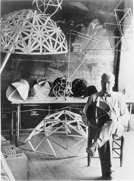
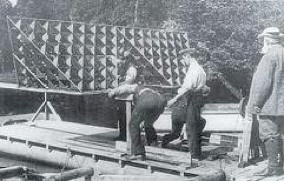
Space frame technology developed from the multiple independent efforts of a variety of inventors and engineers working in diverse fields. Gustave Eiffel’s tower was considered an engineering marvel and succeeded because of it’s triangular frame. The earliest attempt to construct a true space frame was by Alexander Graham Bell, who applied the principles to engineering kites and thus space frame became a critical part of aeronautical design. Decades later, Buckminster Fuller’s investigation of space frame led to the creation of the geodesic dome, the first widespread applied space frame architectural design. In another few decades Fuller’s implementation of space frame to spherical geometry insured his name’s immortality when the third isomer of carbon, and one of the strongest substances known, was discovered to have the same geodesic structure and was, therefore, named buckminsterfullerene. Utilization of space frame technology has rapidly accelerated, in the time since, and now is accessible as the modular construction system StructaPanel.