RADIANT HEATING/COOLING
Radiant cooling refers to systems in which a temperature-controlled surface that cools indoor temperatures by removing sensible heat and where more than half of heat transfer occurs through thermal radiation. Heat will flow from objects, occupants, equipment and lights in a space to a cooled surface as long as their temperatures are warmer than that of the cooled surface and they are within the line of sight of the cooled surface. The process of radiant exchange has a negligible effect on air temperature, but through the process of convection, the air temperature will be lowered when air comes in contact with the cooled surface. Radiant cooling systems use the opposite effect of radiant heating systems, which rely on the process of heat flow from a heated surface to objects and occupants.
Since the majority of the cooling process results from removing sensible heat through radiant exchange with people and objects and not air, occupant thermal comfort can be achieved with warmer interior air temperatures than with air based cooling systems.
Radiant cooling from a slab can be delivered to a space from the floor or ceiling. Since radiant heating systems tend to be in the floor, the obvious choice would be to use the same circulation system for cooled air. While this makes sense in some cases, delivering cooling from the ceiling has several advantages. First, it is easier to leave ceilings exposed to a room than floors, increasing the effectiveness of thermal mass. Floors offer the downside of coverings and furnishings that decrease the effectiveness of the system. Second, greater convective heat exchange occurs through a chilled ceiling as warm air rises, leading to more air coming in contact with the cooled surface. Cooling delivered through the floor makes the most sense when there is a high amount of solar gains from sun penetration, as the cool floor can more easily remove those loads than the ceiling. Chilled slabs, compared to panels, offer more significant thermal mass and therefore can take better advantage of outside diurnal temperatures swings. Chilled slabs cost less per unit of surface area, and are more integrated with structure.
Radiant cooling systems offer lower energy consumption than conventional cooling systems based on research conducted by the Lawrence Berkeley National Laboratory. Radiant cooling energy savings depend on the climate, but on average across the US savings are in the range of 30% compared to conventional systems. Cool, humid regions might have savings of 17% while hot, arid regions have savings of 42%. Hot, dry climates offer the greatest advantage for radiant cooling as they have the largest proportion of cooling by way of removing sensible heat. By coupling the system with building mass, radiant cooling can shift some cooling to off-peak night time hours. Radiant cooling appears to have lower first costs and life-cycle costs compared to conventional systems. Lower first costs are largely attributed to integration with structure and design elements, while lower life cycle costs result from decreased maintenance.¹


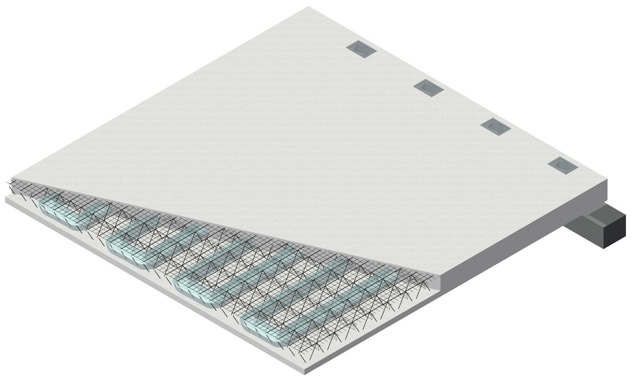
Concrete’s thermal mass, the components, and assembly of StructaPanel make it ideal for use with forced-air radiant heating and cooling to provide the most energy efficient system possible.
Radiant heating is a technology for heating indoor and outdoor areas. Heating by radiant energy is observed everyday, the warmth of the sunshine being probably the most commonly observed example. Radiant heating as a technology is typically more narrowly defined. It is the method of intentionally using mostly the principles of radiant heat to transfer radiant energy from an emitting heat source to an object. Designs with radiant heating is seen as replacement for conventional convection heating.
Radiant heating has a number of advantages: it is more efficient than baseboard heating and usually more efficient than forced-air heating because no energy is lost through ducts. The lack of moving air can also be advantageous to people with severe allergies.
Radiant heating heats a building through radiant heat, rather than other conventional methods such as radiators (mostly convection heating). The technology has existed since the Roman use of hypocaust heating. Underfloor radiant heating has long been widespread in China and Korea. Another example is the Austrian/German kachelofen or masonry heater. The heat energy is emitted from a warm element, such as a floor, wall or overhead panel, and warms people and other objects in rooms rather than directly heating the air. The internal air temperature for radiant heated buildings may be lower than for a conventionally heated building to achieve the same level of body comfort, when adjusted so the perceived temperature is actually the same.
Underfloor and wall heating systems often are called low-temperature systems. Since their heating surface is much larger than with other systems, a much lower temperature is required to achieve the same level of heat transfer. The maximum temperature of the heating surface can vary from 29–35 °C (84–95 °F) depending on the room type. Radiant overhead panels are mostly used in production and warehousing facilities or sports centers; they hang a few meters above the floor and their surface temperature is much higher.
Radiant heating can also be used for snow melting and for roof and gutter de-icing applications. Radiant heating is also used on roofs to eliminate heavy snow loads, ice dams, and icicles that can cause structural damage.²
CONSTRUCTION AND ASSEMBLY VIDEO
-
1.Wikipedia http://en.wikipedia.org/wiki/Radiant_cooling
-
2.Wikipedia http://en.wikipedia.org/wiki/Radiant_heating